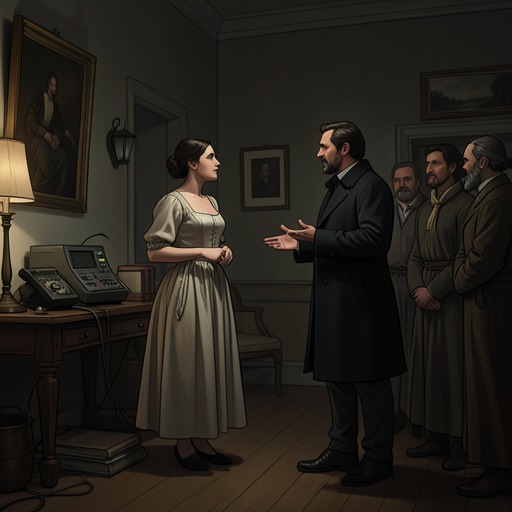
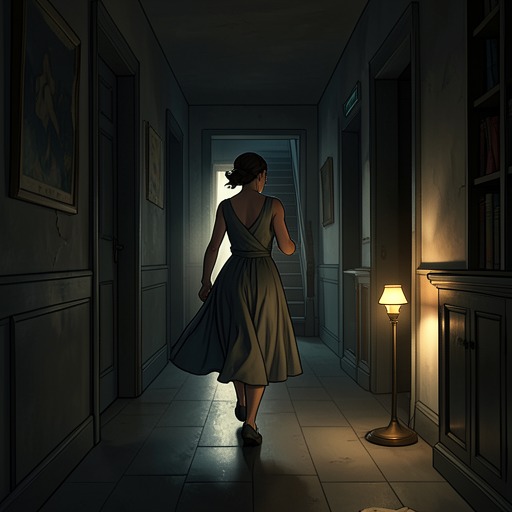
Nancy and the Turnbull sisters investigate the hidden passages
The Hidden StaircaseNancy Drew’s investigation of the hidden passages gives Rosemary Turnbull and Floretta Turnbull a physical explanation for the intrusions and thefts at The Mansion. What had seemed impossible to reconcile with the house’s layout becomes a connected route: a concealed stairway leads into a tunnel toward Nathan Gombet’s house, a hidden panel opens into Floretta’s room, and openings beneath the sofas provide a way into the library and drawing room. The discovery transforms suspicion into a demonstrable method and sends the investigation toward its next objective: bringing Nathan Gombet to justice.
Showing the First Discovery
Nancy does not ask Rosemary and Floretta to accept her accusation on assertion alone. After explaining that Nathan had been trying to frighten them in order to force a sale at his price, she offers to show them her proof. She fetches candles from the kitchen and leads them to the attic, where she lets the sisters enter before her. The trapdoor is still open from her exploration the previous night, and the stairway behind the old highboy is plainly visible in the candlelight. The sisters’ astonishment makes the discovery a revelation not just about Nathan’s access, but about the house they have lived in without knowing its concealed structure.
Nancy explains that the stairway leads to a tunnel connecting The Mansion with Nathan Gombet’s house. Floretta immediately asks whether Nathan has been entering their home nightly by that route, and Nancy says she is convinced he has. Her certainty rests on her own exploration and the connection between the properties; at this stage, however, the sisters still have questions about how particular stolen objects could have been removed without anyone noticing. Rosemary points out that someone reaching the attic stairway from the library would have to pass the bedrooms. The route Nancy has shown them does not, by itself, explain the apparent impossibility of the thefts.
That unresolved detail keeps the discovery from being a complete solution. Nancy admits that she is also puzzled by the removal of The silver urn and advances a theory: there must be another opening to the stairway on the floor below. The investigation therefore moves from exposing one entrance to testing how the passages connect to rooms used by the sisters. The distinction matters: the tunnel explains Nathan’s access to the house, while the lower openings must explain how he could move through it without being heard or seen.
Following the Lower Passage
Nancy leads the way down the wooden stairs, carefully avoiding a broken step. Floretta follows despite her unease at the dust and cobwebs, gathering her skirts so they will not brush against the walls. At a landing, Nancy chooses one of the passages branching in another direction and continues down to a second landing. These details make the exploration a practical search through a hazardous, unfamiliar structure rather than a simple inspection of the visible attic entrance.
A metal ring catches Nancy’s eye. She pulls it, and a section of wall gives way to reveal a closet filled with garments. The opening is in Floretta’s room. Floretta recognizes the room and realizes that the hidden access accounts for her missing silk dresses and diamond pin; Rosemary concludes that Nathan must have entered through the secret panel in the closet. The discovery supplies a direct connection between the passage system and the personal valuables that had disappeared. It also answers Rosemary’s earlier objection: Nathan did not have to emerge from the attic and walk past the bedrooms to reach Floretta’s belongings.
The sisters’ reactions register both the danger and the disorientation of finding a concealed route inside their own home. Floretta had not known the panel existed, and the hidden closet entrance turns familiar rooms into part of a larger, unseen system. Yet one theft remains unexplained: Floretta asks how the canaries could have got in. The discovery of the closet panel solves the route to her dresses and diamond pin, but the conversation does not establish an answer to every individual incident.
Finding the Sofa Openings
Continuing the search, Nancy hears a strange click and identifies what she believes is another panel. With Rosemary holding a candle, she examines the space overhead and pushes against it. The obstruction lifts; Nancy puts her head and shoulders through and finds that the opening leads up through the seat of the library sofa. She pulls herself into the room, then helps Rosemary and Floretta through as well. The sisters’ surprise is sharpened by the fact that the concealed exit was hidden in an ordinary piece of furniture they had lived with for years.
The library opening makes sense of a clue Nancy has kept in mind: the broken step in the passage. She reasons that Nathan must have fallen there and cried out in alarm. She also suspects that the drawing-room sofa conceals a second opening. To test the theory, she removes the cushions and lifts the baseboards; beneath them she finds a similar aperture, just large enough for a person to squeeze through. Floretta then recognizes the route by which Nathan took The silver urn: he had come up through the library sofa rather than entering the room by a path that would take him past the bedrooms.
The paired sofa openings complete a different part of the explanation from the attic stairway and closet panel. The secret stair and tunnel connect the properties; the panel reaches Floretta’s room; the sofa exits provide access to the library and drawing room. Together, these concealed points explain how Nathan could circulate through The Mansion while avoiding the routes the sisters expected an intruder to take. Nancy’s interpretation of the broken step also gives the passage a possible explanation for a noise associated with Nathan’s movement, although she presents it as a theory rather than as a separately witnessed fact.
From Discovery to Action
The search changes the sisters’ position from fearful uncertainty to informed cooperation. Floretta had worried that they could not dare accuse Nathan without proof; now she has seen the stairway, the closet entrance in her room, and the explanation for The silver urn. Rosemary, who had identified the problem with the presumed route, witnesses how the lower passages answer it. The hidden architecture makes the thefts intelligible, even as the unanswered question about the canaries remains distinct from the routes established during this exploration.
Nancy does not linger over the sisters’ gratitude. When Rosemary asks how they can repay her, Nancy says that there is still much to do and insists that Nathan must be brought to justice if possible. Floretta agrees and urges her to call the police so that he can be locked up; Nancy starts toward the door. The investigation thus ends not with the passages themselves as a final resolution, but with proof and an urgent next step. Its decisive shift is from the house’s apparent vulnerability to an understood mechanism of entry—and from private suspicion toward an attempt to secure legal consequences.